

CAO Status Check 2026 helps applicants track the progress of their college or university application online.
Use the official CAO system to check whether your application is being processed, updated, or requires further action.
You can review your application information and monitor important admission updates in one place.
Regular CAO Status Check helps you stay informed and avoid missing important application deadlines or notifications.
Follow this complete guide to learn how to check your CAO application status online in 2026.
What is CAO?
CAO (Central Applications Office) is the central admissions body for four KwaZulu-Natal universities: UKZN, DUT, MUT and UNIZULU. You apply once through CAO to be considered by multiple universities.
CAO Status Check: How to Track Your Application Online
After submitting your CAO application, waiting for an admission decision can be stressful. A CAO status check helps you monitor your application progress, see updates from institutions, and understand whether further action is required. This guide explains the main ways to check your CAO application status, when to check it, what common results mean, and what you should do after receiving an update.for more details vist my home page: https://saservicesinfo.com/

Methods to Check Your CAO Application Status
There are several ways applicants can monitor their application. The online portal is generally the most useful option because it provides access to your My Application information and allows you to review updates for individual programme choices.
1. Check CAO Status Through the Online Portal
The CAO online portal is the recommended starting point for checking your application information. Visit the official CAO website at www.cao.ac.za and use the login details created during your application.After signing in, look for the application or status section. Your CAO application status may be displayed for each programme choice, allowing you to see whether an institution has made a decision or whether your application is still being considered.Keep your CAO number and password secure because you may need them whenever you want to access My Application or review your latest admission information.
2. Use the CAO SMS Service
Applicants may also receive or use CAO SMS services for application-related updates, depending on the services currently offered by CAO. If an SMS option is available, follow the instructions published on the official CAO website and use your correct CAO number.SMS notifications can be useful when you are waiting for an important update, although they may provide less information than the online portal. For detailed application information, completing an online CAO status check is usually more useful.
3. Check Your Email
CAO status check and institutions may use the email address provided during your application to communicate important updates. These messages can relate to application progress, admission decisions, offers, or additional instructions.Check your inbox regularly and also look in your spam or junk folder. If your contact information has changed, make sure your details are updated through the appropriate official channel.
4. Contact the Relevant University
If you need information about a particular programme or institution, you may need to contact the relevant CAO status check university’s admissions office. This can be especially helpful when your application has already been forwarded to an institution and you require clarification about a programme-specific issue.For university-specific questions, use contact details published by the institution itself rather than relying on unofficial websites or social media posts.
When Should You Check Your CAO Status?
Knowing when to CAO Status Check can save you time and reduce unnecessary worry. Application processing can take time because CAO Status Check CAO and institutions need to assess applications, verify information, and consider admission requirements.

Understanding the CAO Application Timeline
After submitting an application,CAO Status Check the information may go through verification and processing before institutions evaluate your programme choices. Admission decisions can also depend on academic results, programme requirements, available spaces, and other institutional factors.Once final school results become available, institutions can make further decisions based on updated academic information. As a result, applicants may receive different updates at different stages of the admission cycle.A CAO status check is particularly important during periods when universities are actively making admission decisions. Instead of checking repeatedly throughout the day, check your account regularly and pay close attention to any new communication.
How Often Should You Check?
There is no advantage to checking your application every few minutes. During the early processing stage, occasional checks are generally sufficient. As admission decisions and offers begin to move more quickly, checking your CAO application status more regularly can help you respond within any required deadline.If you receive an email or SMS telling you that your application has changed, log in and review My Application as soon as possible.
Understanding Your CAO Status
A CAO Status Check status displayed in your account provides information about where your application currently stands. The exact wording can vary, so applicants should always consider the information shown in their official account and any instructions provided by the relevant institution.
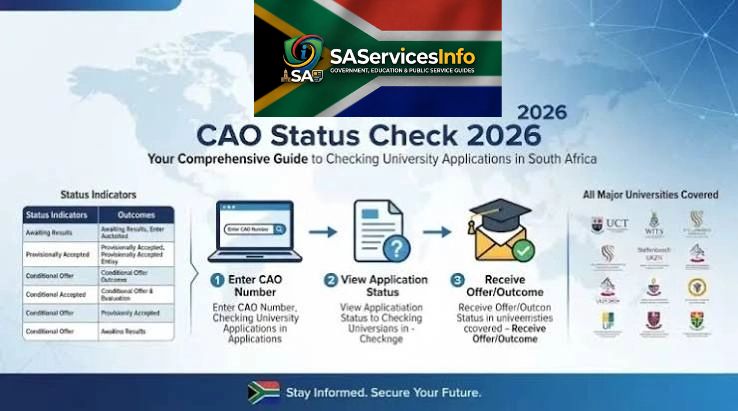
Application Received
This generally means your application has been received and is in the processing system. It does not necessarily mean that a final admission decision has been made.
Under Consideration
This indicates that your application is being assessed. The institution may still be reviewing your academic information, programme requirements, or available places.
Conditionally Accepted
A conditional decision means you may have been offered admission subject to certain requirements being satisfied. Read the conditions carefully and make sure you complete any required steps before the stated deadline.
Accepted
An accepted status indicates that you have received an admission offer for the relevant programme. Check the accompanying instructions carefully because you may need to accept the offer or complete additional registration steps.
Waitlisted
A waitlisted application may meet the required criteria, but a place may not currently be available. Admission can depend on spaces becoming available later in the process.
Unsuccessful
An unsuccessful result means you were not offered admission for that particular programme. Do not assume that every programme choice will necessarily have the same result because choices can be assessed separately.
Troubleshooting Common CAO Status Check Problems
Cannot Log In
If you cannot access the portal, first check that you are entering the correct CAO number and password. If you have forgotten your password, use the official password-recovery option where available.
Avoid creating multiple accounts unnecessarily, as this can create additional confusion when trying to access your application.
Your Status Has Not Changed
A status remaining unchanged for some time does not automatically mean that there is a problem. Applications can remain under review while institutions process a large number of applications.If you believe your application should have been updated or you have been waiting for an unusually long period, contact CAO through its official communication channels and provide your application details.
Different Results for Different Choices
It is possible for different programme choices to have different outcomes. One choice could be accepted while another remains under consideration or receives an unsuccessful decision.Therefore, review every programme listed in My Application rather than assuming that one result applies to all your choices.
What to Do After Checking Your Status
If You Are Accepted
Read the admission instructions carefully and accept the offer within the specified timeframe if required. You should also check registration information, accommodation options, funding arrangements, and any documents that the institution asks you to provide.
If You Are Waitlisted
Continue monitoring your account and email because your position may change if places become available. At the same time, consider alternative study options so you have another plan if the programme does not become available.
If Your Application Is Unsuccessful
Do not immediately assume that your entire application has failed. Review the result for each programme choice and check whether other choices remain under consideration.You can also investigate alternative programmes, institutions, future application opportunities, or other suitable study pathways.
Final Tips for Applicants
Keep your CAO number, login details, and application information in a safe place. Check your email and official CAO account regularly, especially when admission decisions are being released. If you need clarification, use official CAO or university contact channels rather than relying on unofficial information.Most importantly, use the official portal whenever you perform a CAO status check. Keeping your information accurate and responding promptly to admission offers or requests can help you avoid unnecessary delays throughout the application process.
What to Do If Your CAO Application Is Unsuccessful
Receiving an unsuccessful CAO status check can be disappointing, but it does not mean your education journey has to stop. There are several options available, including changing your programme choices, applying directly to institutions, considering TVET colleges, taking a productive gap year, or exploring alternative education pathways.
Why Is a CAO Application Unsuccessful?
Common Reasons for Rejection
An application may be CAO status check unsuccessful for several reasons. These can include an APS score below the programme requirement, not having the required subjects, a programme reaching its available capacity, an incomplete or late application, or missing or invalid documents.
For example, some programmes may require specific subjects such as Mathematics or Physical Sciences rather than Mathematics Literacy. Even when an applicant meets the general admission requirements, competition for limited spaces can affect the final outcome.
How to Find the Reason for Rejection
If you want to understand why your application was unsuccessful, contact the relevant university’s CAO admissions office directly. Keep your CAO number and student information available when making an enquiry. Ask whether the programme has a specific admission requirement you did not meet and whether there are alternative programmes or future application options available.
What Can You Do After an Unsuccessful CAO Application?
Option 1: Change Your CAO Programme Choices
If the CAO application process is still open and changes are permitted, you may be able to review or change your programme choices. Look for programmes with requirements that better match your qualifications.You could also consider similar programmes at another institution or an extended programme that provides additional academic support. Before changing your choices, compare the admission requirements carefully and make sure you meet the criteria.
Option 2: Apply Directly to Universities
Some institutions and programmes may accept applications directly outside the main CAO Status Check process. Depending on availability, universities may have opportunities for late applications, remaining spaces, or additional intakes.Contact the university directly to find out whether applications are still open and whether your preferred programme accepts direct applications. Do not assume that every programme will have spaces available.

Option 3: Consider TVET Colleges
TVET colleges are another option for students who want practical, career-focused education. They offer programmes in areas such as business, engineering, hospitality, information technology, and other vocational fields.The source material highlights several TVET colleges in KwaZulu-Natal, including Coastal KZN TVET College, Elangeni TVET College, Esayidi TVET College, Majuba TVET College, Mnambithi TVET College, Mthashana TVET College, Thekwini TVET College, Umfolozi TVET College, and Umgungundlovu TVET College.TVET education can provide practical skills and may offer pathways toward further study. Eligible students may also investigate available NSFAS funding.
Option 4: Take a Productive Gap Year
A gap year can be useful when it is planned around specific goals. Instead of simply waiting for the next application cycle, you can use the time to upgrade matric subjects, improve your results, gain work experience, earn money, or complete relevant short courses.Improving your academic results can strengthen your future application. You can then apply again during the next CAO cycle with improved qualifications and a clearer understanding of your programme choices.
Option 5: Explore Alternative Education Pathways
CAO Status Check University is not the only route to building a career. Depending on your interests and qualifications, you can explore private higher education institutions, online learning, professional certifications, apprenticeships, learnerships, and distance-learning opportunities.Some careers may also be accessible without a traditional university degree. The important thing is to choose a pathway that matches your abilities, career goals, finances, and academic circumstances.
Planning for a Future CAO Application
If you decide to apply again, create a clear plan rather than submitting the same application without making improvements.
| Action | Suggested Period | Purpose |
|---|---|---|
| Upgrade matric subjects | February–November | Improve academic results and APS |
| Research programmes | March–June | Select realistic programme choices |
| Submit CAO application | April–September | Apply before the relevant deadline |
| Prepare funding application | September–January | Investigate available funding |
| Prepare documents | Ongoing | Keep application information complete |
The exact dates can change, so applicants should verify current deadlines and requirements before relying on a particular date.
Can You Apply Again After Rejection?
Yes, CAO Status Check an unsuccessful application does not prevent you from planning for a future application cycle. Apply for cao status check :https://www.cao.ac.za/. Before applying again, identify what affected your previous result. You may need to improve your APS score, meet a subject requirement, choose programmes with more realistic entry requirements, or provide complete documentation.Research your programme choices carefully and compare your qualifications with the published admission requirements before submitting a new application.
Keep the Right Mindset
An unsuccessful application does not determine your future. Your first-choice programme may not work out, but alternative routes can still lead toward your career goals.Focus on the areas you can control: improving your qualifications, developing useful skills, researching realistic study options, and preparing a stronger application. If you are unsure which direction to take, consider speaking with a career counsellor at your school or seeking guidance from a suitable youth-development organisation.
Key Takeaways
- Find out the specific reason your CAO status check application was unsuccessful.
- Check whether you can change your programme choices while applications are open.
- Contact universities about possible direct or late application opportunities.
- Consider TVET colleges for practical and career-focused qualifications.
- Use a gap year productively by improving results and developing new skills.
- Explore alternative pathways such as learnerships, apprenticeships, certifications, and distance learning.
- If you reapply, choose programmes carefully and prepare your documents in advance.
An unsuccessful CAO application is a setback, not necessarily the end of your plans. By understanding what went wrong and considering alternative options, you can create a practical route toward further education and your long-term career goals.
What Provisional Acceptance Means
If your CAO status shows “Conditionally Accepted” or “Provisionally Accepted,” it is positive news, but it is not the same as receiving a final or firm offer. A provisional acceptance means the university is prepared to offer you a place provided that you meet the conditions attached to the offer after your final matric results are available.
How Provisional Acceptance Works
Universities may make provisional offers using the academic information available before final matric results. The decision can be based on results such as June or September examinations submitted with your CAO application. Because final matric results are released later, the university places conditions on the offer.In simple terms, provisional acceptance means the university is saying that your current results indicate that you may qualify, but your final results must still satisfy the programme’s admission requirements.
Common Conditions Attached to a Provisional Offer
A provisional offer may include one or more requirements, such as:
- Minimum APS score: Your final APS must meet or exceed the programme’s required score.
- Specific subject requirements: Certain programmes may require particular subjects or minimum marks.
- NSC pass type: Degree programmes may require a Bachelor’s pass, while diploma programmes may have different requirements.
- English requirement: Some programmes require a minimum level in English.
- Final academic performance: A significant decline in your final results may affect the offer.
Always read the actual conditions stated in your offer because requirements can differ between programmes and institutions.
What to Do After Receiving Provisional Acceptance
Step 1: Read the Offer Carefully
Start by reviewing the complete offer letter. Check the programme name, campus, conditions, response deadline, and any documents or other requirements mentioned by the institution.Make sure the programme and campus offered match what you expected. If the university has offered you an alternative programme or campus, review the details before making a decision.
Step 2: Accept the Offer Before the Deadline
If you want to take the place, follow the university’s instructions for accepting the offer. The exact process and deadline can vary, so do not rely on a general timeframe.You may be required to respond through an online system, submit documents, or complete other instructions. Missing the deadline could put your place at risk.
Step 3: Maintain Your Academic Performance
A provisional offer should not be treated as a guaranteed place. Continue preparing for your final matric examinations and focus particularly on subjects mentioned in your offer conditions.Your final results will determine whether you satisfy the requirements attached to the provisional acceptance.
Step 4: Prepare for University Registration
While waiting for your final results, you can begin preparing for the next stage. Depending on your circumstances, this may include researching accommodation, checking funding information, preparing a student budget, and keeping your documents ready for registration.
What Happens After Final Matric Results?
Your final results determine what happens to the provisional offer.
| Final Result | Possible Outcome | What You Should Do |
|---|---|---|
| You meet all conditions | Offer can become firm | Follow the university’s registration instructions |
| You exceed the requirements | Offer can be confirmed | Check whether further opportunities are available |
| You narrowly miss a condition | Outcome depends on the institution/programme | Contact admissions immediately |
| You significantly miss requirements | Offer may be withdrawn | Ask about alternatives or other options |
| Your results differ from expectations | Outcome varies | Contact the relevant admissions office |
The final decision depends on the conditions set by the university and the programme. If you are unsure about your position, contact the institution directly.
What If Your Provisional Acceptance Is Withdrawn?
If your final results do not satisfy the conditions, do not assume that there are no other options. Contact the university as soon as possible and ask whether you qualify for another programme with different admission requirements.You should also review your other CAO choices because you may have received a different outcome for another programme. If none of the options work out, consider alternative study pathways or applying again in a future cycle.A gap year can also be used productively to improve your academic results, develop skills, and prepare a stronger application.
Provisional Acceptance vs Firm Acceptance
The main difference is the conditions attached to each decision.A provisional acceptance depends on you meeting specified requirements, particularly those relating to your final academic results. The university can reconsider or withdraw the offer if those conditions are not met.A firm acceptance, on the other hand, means the relevant admission conditions have been satisfied and the institution has confirmed your place. You should still follow the university’s registration instructions and meet any remaining administrative requirements.
Yes. If you do not meet the condition
Key Takeaways
- Provisional acceptance is good news, but it is conditional.
- Read every requirement attached to your offer.
- Follow the university’s acceptance instructions before the stated deadline.
- Continue working hard until your final matric results are released.
- Check your final results against every condition.
- If the offer is withdrawn, contact admissions quickly and explore alternative programmes or pathways.
The most important thing is to understand exactly what your university has asked you to achieve. Your provisional offer gives you a potential place, but meeting its conditions is what allows that opportunity to move toward confirmed admission.\
Understanding the CAO status check Waitlist Process
If your CAO Status Check shows “Waitlisted” or “On Waiting List,” it generally means you meet the programme requirements, but there is currently no available place. Being waitlisted does not mean you have been rejected. Your application may still move forward if accepted applicants decline their offers, fail to meet final requirements, or do not register.
Why Do Universities Use Waitlists?
Universities have limited spaces in each programme. Capacity can depend on factors such as lecture rooms, laboratory facilities, clinical placements, staff-to-student ratios, and accreditation requirements.Because some students may decline offers or decide not to attend, universities can maintain a waiting list of qualified applicants. When places become available, applicants from the waitlist may be considered for admission.
How Is Your Waitlist Position Determined?
Waitlists may take academic performance into account, including your APS score and, for some programmes, specific subject results. Other factors may also influence selection, such as programme requirements, institutional policies, and available spaces.The exact position of an applicant on a waitlist is not necessarily disclosed. Therefore, your APS score can provide some context, but it cannot guarantee that you will receive an offer.
When Does Waitlist Movement Usually Happen?
Waitlist movement can occur when accepted students decline offers, fail to meet final requirements, or do not register.
| Period | What May Happen | Expected Movement |
|---|---|---|
| December–Early January | Students accept or decline provisional offers | Moderate |
| Mid-January | Final matric results become available | High |
| Late January | Registration deadlines pass | High |
| February | Remaining spaces may be filled | Moderate |
| March–April | Some spaces may open after early withdrawals | Low |
The timing and amount of movement can vary by university and programme.
What Should You Do While on the Waitlist?
1. Accept Other Offers
If you have received an offer for another programme, consider accepting it as a backup while waiting. This can help ensure that you have a study option if your preferred programme does not become available.Review all your programme choices rather than focusing only on the one where you are waitlisted.
2. Keep Your Contact Details Updated
Make sure the email address and cellphone number associated with your application are correct.CAO status check Universities may use these contact details to communicate important updates.CAO status check Check your email regularly, including your spam or junk folder, and pay attention to messages or calls during periods when waitlist movement is likely.
3. Respond Quickly to Any Offer
If a place becomes available, you may receive instructions explaining how and when to accept it. CAO status check Read the communication carefully and respond within the stated deadline.Do not assume that a waitlist offer will remain available indefinitely. If you miss the institution’s deadline, the place may be offered to another applicant.
4. Contact the University
If you need clarification, you can contact the CAO status check or relevant admissions office and politely ask about your application. You may ask whether there has been movement on the waiting list or whether other programmes have available spaces.Keep your CAO number and application information ready when making an enquiry.
5. Prepare Financially
A waitlist offer can sometimes require quick action, particularly when registration deadlines are approaching. Keep your important documents ready and check your funding arrangements.If you have applied for NSFAS or another funding option, continue monitoring its status so you are prepared if your admission changes.
What Are Your Chances of Getting Off the Waitlist?
There is no single success rate that applies to every university or programme. Waitlist movement depends heavily on programme demand, available capacity, and the number of accepted applicants who ultimately register.Highly competitive programmes such as Medicine, Law, and Engineering may have significant demand and limited spaces. CAO status check Other programmes may experience more movement if a larger number of accepted students choose alternative institutions or programmes.Your academic results can also provide some indication of how competitive your application is, but being above or near a programme’s minimum requirement does not guarantee a waitlist offer.
Key Takeaways
- Being waitlisted does not mean your application was rejected.
- A waitlist usually means you meet the relevant requirements but there is currently limited space.
- Accept a suitable backup offer if one is available.
- Keep your phone number and email address updated.
- Respond quickly if the university sends you a waitlist offer.
- Waitlist movement can increase around final results and registration deadlines.
- Always keep a Plan B, such as another programme, institution, TVET college, or future application cycle.
FAQ’s
You can tell if your application is rejected by looking for specific clues: an instant automated rejection email, a long silence past the stated timeline, or the job post being taken down.
Clear Signs of Rejection
- Instant Email: Getting a “thanks but no thanks” message minutes after applying often means you failed a basic automated filter or “knockout question”.
- No Follow-Up: Waiting two to three weeks without any message usually means you did not move forward.
- Removed Listing: Finding that the job or rental listing was deleted or marked as filled/rented.
- Portal Status: Checking the employer’s online hiring portal and seeing “closed,” “archived,” or “not selected.”
What You Can Do Next
- Reach Out: Send a polite, short note to the hiring manager or landlord to ask if the position is still open.
- Check for Errors: Look back at your materials for missing info, wrong contact details, or missing keywords.
- Move Forward: Do not wait for a reply if weeks have passed; keep applying to new places.
The Central Applications Office (CAO) sends an initial acknowledgment letter within two weeks of receiving a valid application. However, actual admission decisions come from the individual universities rather than the CAO [15.15]. These responses typically arrive anywhere from November through January, with many final decisions delayed until after matric results are released.
Application Response Timeline
- Initial Acknowledgment: Sent via email within 2 weeks after the CAO processes your submission.
- Evaluation Period: Universities review applications between November and January.
- First Offers: Early offers roll out starting mid-November.
- Final Decisions: Most remaining offers or rejections finalize in January once final school results are available.
Tracking Your Status
- Check Online: Log into your profile on the Official CAO Website to view live updates.
- Community Feedback: Users on Reddit agree that response times can heavily lag during peak processing windows, so checking the specific university portal directly can sometimes yield faster insights.
It typically takes up to 3 days for payments to process and reflect in the Central Applications Office (CAO) system. However, payments made via retail outlets (like EasyPay in Shoprite, Pick n Pay, or Checkers) often confirm by the next working day, while online card payments or instant EFT options may update quicker. CAO: Home +1
Processing Details
- Online / EFT / Direct Deposit: Up to 3 business days to fully process.
- Retail Outlets (EasyPay): Usually reflects by the next day.
- Confirmation: You will receive a confirmation SMS or email once it clears, and your application status will update on the CAO website.
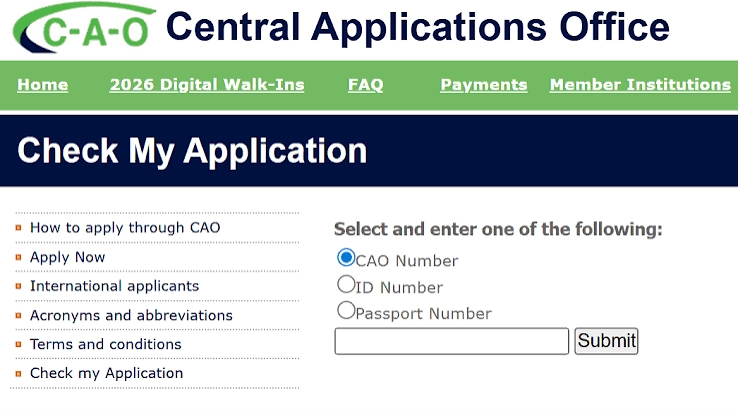
To check your Central Applications Office (CAO) status using your ID number, visit the Central Applications Office website, click the “Check My Application” link on the homepage, and enter your ID or passport number to view your current progress. CAO: Home
Online Status Check Steps
- Go to the official Central Applications Office portal.
- Click on Check My Application on the homepage.
- Type in your ID number or Passport number.
- Submit the form to view your program choices and current application results.
“Regret unsuccessful” on your Central Applications Office (CAO) status means the school or college has decided not to offer you a place in that specific course.
Why You Got This Status
- Low marks: Your school results did not reach the minimum score or cut-off points needed for the course.
- No space left: Too many students applied, and the school ran out of open spots.
- Failed tests: You did not pass a required entrance exam, interview, or portfolio check.
CAO: Home +1
What You Can Do Next
- Change your choice: Look for open courses on the Central Applications Office website and submit a change request for a different program.
- Check directly: Some users on Facebook note that you can double-check the specific university’s own student portal just to make sure their system matches the CAO update.
You will know your application is approved when you receive an official notification via email, SMS, or an online portal status update. For tips on how to check your application status on an online portal:
Check your application status on the portal and make sure to ACCEPT or…
Checking Methods
- Online Portal: Log in with your username, ID, or student number on the specific organization’s website. Look for terms like “Offer Received,” “Admitted,” or “Approved”.
- Direct Messages: Check the email address or phone number you used to apply for an SMS or official letter.
- Status Meanings: “Provisional” means you need final results, while “Approved” or “Successful” means complete acceptance.
Firm Offer: You have been offered a place in the programme. Conditional Offer: You have been offered a place subject to meeting specific conditions (e.g. submission of outstanding results or documentation). Offer with Residence: You have been offered a place in the programme together with residence accommodation.
For the July 2026 Second Semester, South African applicants who submit their applications by 31 May 2026 pay an on-time application fee of R250, while late applications submitted from 1 June 2026 are charged R470. For international applicants, the on-time fee is R300, increasing to R580 for late applications.
7.4. I overpaid in error; I would like to request for a refund. You may email your request and banking details to [email protected] in order for CAO to process your request. Please be advised that a 10% handling fee will be deducted from your payment for administration and bank charges.
To see if your Central Applications Office (CAO) payment is approved and processed, visit the official Central Applications Office Website, click on “Check My Application,” and log in using your CAO ID or ID/passport number to view your updated application and payment status.
Steps to Check Your Status
- Go to the CAO Official Portal.
- Select Check My Application.
- Enter your CAO number or ID/Passport number.
- Review the status screen to confirm if your payment reflects as received and your application has been released for processing.
Important Details to Keep in Mind
- Processing time: Online card payments usually reflect quickly, but payments made via EasyPay at retail partners can take a few days to update in the system.
- Acknowledgement Letter: Once your full payment is successfully processed, the CAO will issue an Acknowledgement Letter confirming your application is active and sent to your chosen institutions.
- Mixed experiences: On social platforms like Facebook, opinions are mixed; some users note that status updates can occasionally lag, requiring you to email your proof of payment to
[email protected]if it remains outstanding.
Waiting for a decision” on your Central Applications Office (CAO) status means the university or college has received your on-time application, but they have not yet looked at it or made a choice.
What This Status Tells You
- On-time submission: Your application and fee arrived on or before the closing date.
- Priority place: You get first-line priority before late applications are looked at.
- Not reviewed yet: The school has your files, but a final choice is still pending.
What You Should Do Next
- Check details: Log in to the CAO Website to make sure all your personal info and marks are correct.
- Wait for updates: The status will change to an offer, a waitlist, or a regret once the school reviews your file.
- Mixed opinions: Opinions are mixed on Reddit regarding whether calling the office helps speed up the process, as some students are told to wait while others get direct updates.
Conclusion
The CAO status check is an important part of the application journey because it allows applicants to follow their application progress and review updates for their programme choices. The official CAO Status Check website provides a Check My Application option where applicants can enter their CAO number, ID number, or passport number to view their current status.Whether your application is Waiting for a Decision, Awaiting Results, Conditionally Accepted, Waitlisted, Accepted, or Unsuccessful, understanding the status helps you decide what to do next. If you receive provisional or conditional acceptance, carefully follow the institution’s requirements and deadlines. If you are waitlisted, keep your contact details updated, monitor your application, and maintain suitable backup options. If your application is unsuccessful, consider alternative programmes, other institutions, TVET colleges, or a future application cycle.Regularly reviewing your CAO application status and keeping your documents and contact information up to date can help you avoid missing important instructions. For the most reliable information, always use the official CAO website and follow communication received directly from CAO or the relevant institution.
TUT Status Check 2026: Complete Guide to Track Your Application Status Online
UIF Login: Guide to Register & Check UIF Status Online 2026
How To Update Srd.Sassa.Gov.za Banking Details SRD R350 GRANT in 2026